
Releases from Marion County Circuit and District Courts
Marion County Circuit and District Courts do not release people from a cell, but court records often explain why a jail stay ended. The sheriff record can show that a person left custody. The court file can show bond, dismissal, no bill, nolle prosequi, sentence, probation, revocation, time served, or transfer to state custody.
When the sheriff roster is offline or a release has aged out of an online view, the court record becomes the durable route for the legal reason behind the release.
How to Confirm a Release from Marion County Circuit and District Courts
Use the Circuit Clerk public-search and copies process for release-reason records. The clerk page says a public access terminal is available inside the office for public record name search, and it points remote users to Alacourt / Just One Look for immediate online access.
- Search by name at the clerk's public terminal or through Alacourt Access.
- Match the case by party name, case number, date of birth, alias, charge, and case type where available.
- Request the docket, case-action summary, bond order, release order, sentencing order, probation order, or disposition order.
- Use the sheriff release record to confirm the custody event and the court record to confirm the legal reason.
Marion County Circuit and District Courts Records and Contact
Written requests should include requester contact information, documents needed, certification request if any, case identifiers, and mailing or pickup instructions. The clerk states that written requests may take up to 30 days because of minimal staffing.
Marion County Circuit Clerk Records
P.O. Box 1595
Hamilton, AL 35570
Public search: in-office terminal
Online access: Alacourt / Just One Look
| Copy item | Fee |
|---|---|
| Copies up to 20 pages | $5.00 |
| Each page after 20 | $0.50 |
| Certification | $5.00 |
About Marion County Circuit and District Courts
The Marion County Circuit Clerk page states that most court records are public and open for inspection, with exceptions. It gives request instructions, copy fees, and a local public terminal. Court records are especially important in Marion County because the sheriff roster was offline during research and the court file may be the only available public path to the release reason.
The clerk public-search page documents the local process.
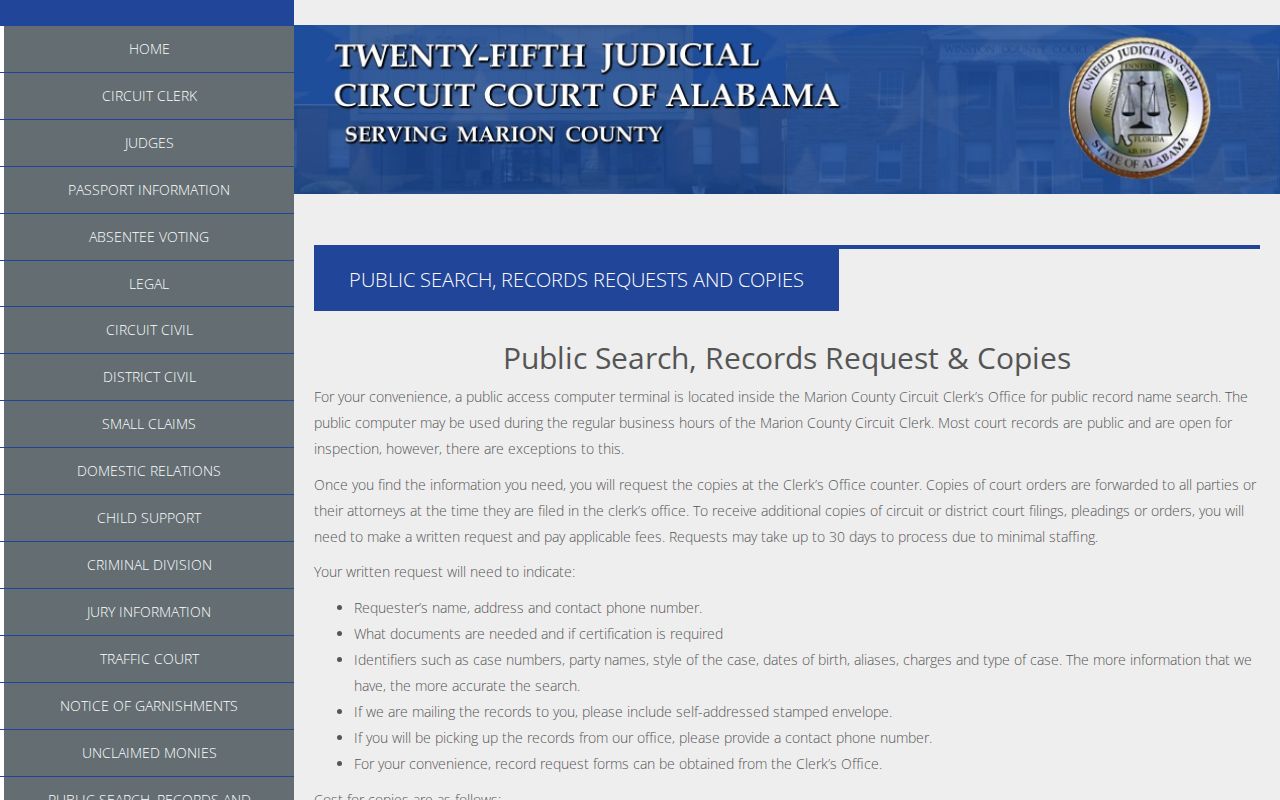
The clerk page is a records-copy source, not a jail roster. Pair it with the sheriff when the question is whether custody ended.
Court Fields That Explain Release
Useful court fields include case number, party names, charges, bond entries, disposition, sentence, probation order, revocation order, and case-action summary. These records can distinguish a bond release from a sentence, dismissal, transfer, or probation event.
Match Court and Jail Records
The court record and sheriff record should be read together. The jail record shows the custody event; the court record explains the authority for that event. If the jail record says transfer, the court may show sentence or hold information. If the court shows a bond order, the sheriff record can show whether the person actually left custody.
Written court requests should be specific. Ask for the case-action summary, bond order, release order, sentencing order, probation order, disposition order, or certified copy needed. Include party names, aliases, dates of birth if known, case number, charges, case type, mailing or pickup instructions, and a phone number. Broad requests can take longer, and the clerk page already warns that staffing can affect turnaround.
Sealed or Expunged Records
Alabama expungement can affect what court and arrest records remain public. Section 15-27-1 allows petitions for certain misdemeanor, violation, traffic, and municipal-ordinance records under listed conditions, plus some misdemeanor convictions after completion of probation or parole requirements and other statutory conditions. If a record is sealed, expunged, juvenile, youthful-offender, or otherwise restricted, the clerk may not release the same information shown in an ordinary public case file.
Expungement is not a shortcut for every public copy. A court order affects official records according to law and the order's terms. It may not automatically remove news stories, screenshots, or third-party copies. For release research, the practical question is whether the official custodian can still provide the public release or disposition record.
Court Request Checklist
For a release-reason search, request the case-action summary first if the case number is known. Then ask for the specific order that explains custody: bond order, release order, sentencing order, split-sentence order, probation order, dismissal order, revocation order, or transfer-related order. If certification is needed, say so in the request and include the listed certification fee.
Use court dates and order dates to line up the jail release timeline. A bond order may be signed before the person physically leaves jail. A sentence may be entered before transport to ADOC. A revocation may explain a later return to custody. The record is strongest when the court order and sheriff release record point to the same event.